





Muhammad pocket guide
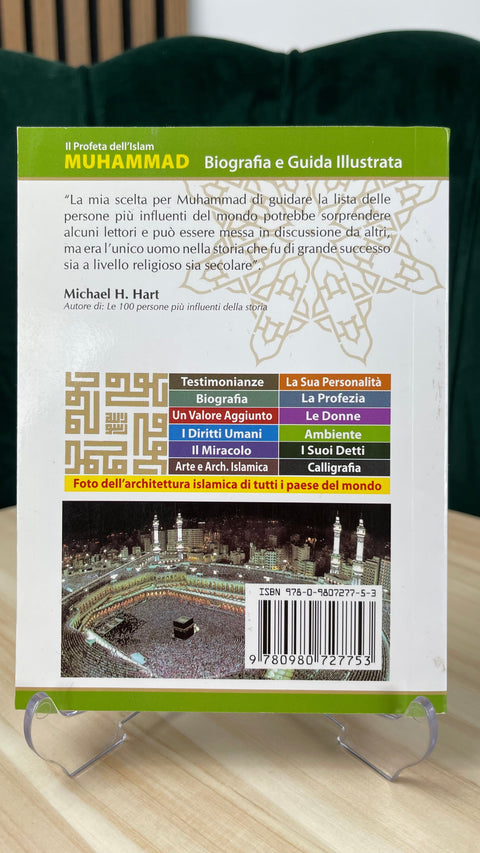
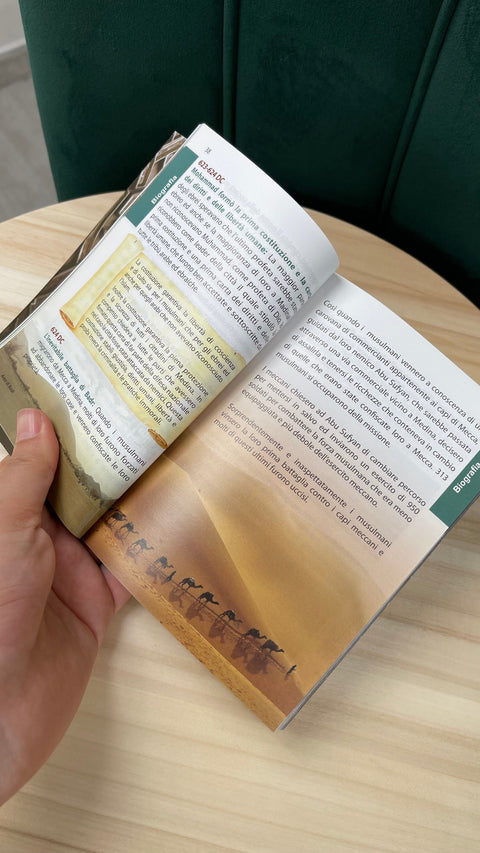
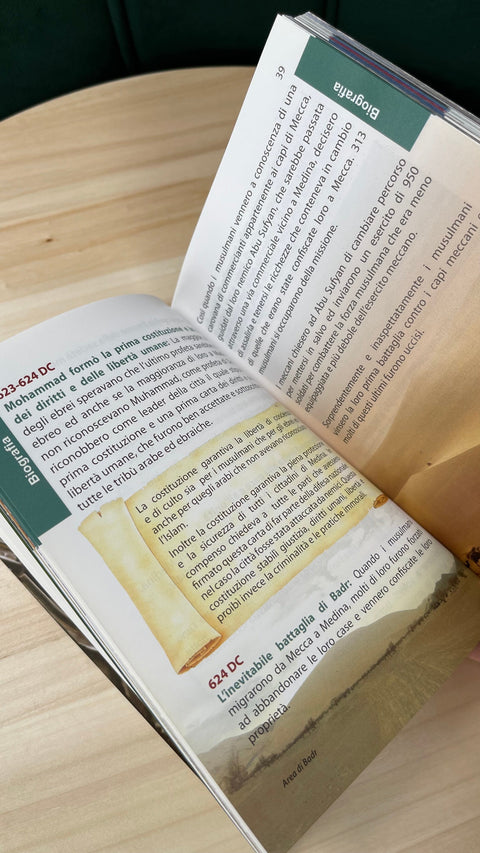
The Muhammad pocket guide is an illustrated, concise yet comprehensive text on the life of the Prophet Muhammad (peace and blessings be upon him). This guide provides information about the Prophet's character and details about his private life, and also offers an overview of his teachings and the major events that characterized his exemplary life.
IMPORTANT NOTES
When Muslims mention the name of Muhammad, it is a religious obligation, as a sign of respect, to say: "Peace and blessings of Allah be upon him". In this book and in many other publications related to the Prophet Muhammad, this is abbreviated as "peace and blessings be upon him"
"pbsl" which in Arabic is written like this: (*9).
However, since this is a pocket guide where the name of the Prophet Muhammad (pbsl) often recurs, it may be omitted in some parts for space reasons and so as not to distract the non-Muslim reader; not out of disrespect.
• The pocket guide in many of its parts refers to God as "Allah" (the specific name of God the Almighty). This
"name" cannot be used for any other living being. Any publication containing the name of God (Allah) must be treated with respect and must be kept in places worthy of this sentiment
We thank the reader who will take care of this booklet.
On the other hand, wherever the word God or
Lord appears in the guide, it refers to Allah (Glory to Him).
Muslims believe in one God (the only deity) who created the world, the earth, the heavens, the cosmos, and all living beings (belonging to all worlds).
According to the Islamic creed, Allah possesses many attributes and names that describe Him and His actions, such as the Loving (Al-Wadud, in Arabic), the Holy (Al Quddus in Arabic or hakkadosh "'The Only Holy" in Hebrew). The Only (al Ahad in Arabic and Echad in Hebrew), Peace (Al Salam in Arabic, Shalom in Hebrew). But the main Name is Allah, Glory to Him.
In Hebrew, God is named "Elohim" and in Aramaic "Elah-Alaha".
The first chapter of the Holy Quran "The Opener" introduces God with the following words: "Praise be to Allah, Lord of the worlds, the Compassionate, the Merciful".
- The word "Makkah", which is the birthplace of the Prophet Muhammad (pbsl), is written in many books as "Mecca". Both forms of writing are present in this guide. The city of Mecca is located in the valley of Bakkah, known as "Becca" in the Old Testament. Furthermore, the word "Medina" refers to the city where the Prophet Muhammad (psbl) emigrated. In Arabic it is called
"Al-Madina al-Munawwara "which means the illuminated city. -
The information available in this guide is drawn from authentic sources according to the author's best knowledge. Any printing errors or other possible types of errors are unintentional, and for these we apologize. Readers can send their comments by email to the address available in the pocket guide.
I am honored to have had the time and the ability p
I am honored by the use of the Prophet alnari nad
(peace and blessings be upon him), the man who illuminated the hearts of millions of people in the world, leading them to faith and submission to the One God: the Lord of the
Worlds and of all living beings.
I spent a pleasant time writing and assembling this guide, where I learned that a good job requires time and dedication. The facts contained therein are precious and require personal knowledge of the subject and efforts to retrieve and transmit them in the most correct and complete manner possible.
This project (producing a pocket guide) brought me very close to the life, sayings, and actions of the Prophet Muhammad (pbsl), whom I undoubtedly love and admire.
The more I know and understand his teachings and ways of living, the more motivated I am to present his virtues and his important sayings (ahadith), which are an example of excellent behavior for the whole world, and I will try to do so in a simple and precise way.
Muhammad (pbsl) is the man who dedicated his life to the noble cause of Allah, humbly describing himself as the last brick that completes a magnificent building. This building is the metaphor for the whole of all the prophets and messengers sent by God to humanity to guide to the truth and teach not to
fall into disbelief and sin. This process began with Adam, the father of humanity, followed by many prophets and messengers (recognized by Jews, Christians, and Muslims) such as Noah, Abraham, Moses, David, Solomon,
Zechariah, John, and Jesus (peace be upon them).
Many readers wonder why Islam does not have special rites or commemorative rituals for the Prophet himself. Even the pilgrimage to the sacred mosque in
Mecca is primarily an Abrahamic rite, for the Prophet Abraham represents a great example (in history) of submission to God. He was the first person who built a house and erected its walls in its current form to glorify Allah, the One God, the Lord of the
Worlds and of living beings.
The Prophet Muhammad (pbsl), after 21 years of hard work, removed all the idols of paganism from this house, restoring it to its natural state and purpose, a pure house for Allah, the Lord of the Worlds and of all creatures, where all those who believe in Him can go to worship Him.
Muhammad (pbs|) respected all the prophets and messengers who preceded him, recognizing Jesus with special honor, giving all believers glad tidings that the son of Mary the Virgin would return one day, before
the end of life on this earth. He will fight sin, bringing an end to conflicts and uniting the believers under his banner. Muhammad (pbsl), before dying, reminded Muslims to follow Jesus when he returns, warning them against the false messiah: the Antichrist.
This illustrated guide uses friendly language with a simple and illustrative reading style. It was written especially for tourists who visit Muslim places and want to access brief information from authentic Islamic sources. Muhammad is the man who never declared or claimed to have created a new religion but presented himself as the Messenger of God.
This pocket guide is divided into colored chapters and bold paragraphs for easy and quick reading.
I am deeply grateful to Mr. Chabani Ibrahim, Mrs. Cinzia Rodolfi, Sylvana Mahmic, Vicki Snowdon,
Peter Gould, Dr. Zachariah Mathews, Dr. Jassem Al
Mutawaa, Cyrille Bouzy, and Dr. Ibrahim Al-Adsani, who contributed valuable comments to improve the presentation of the text and its contents in this pocket guide.
Dr. Sam Deeb
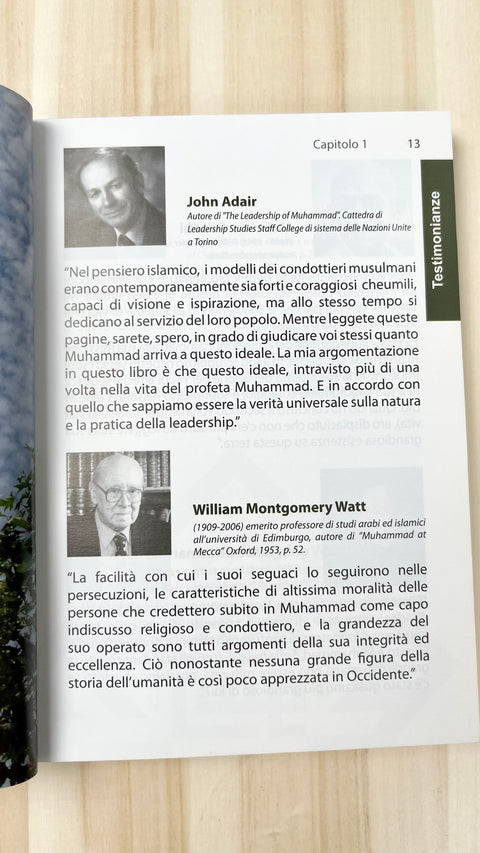
John Adair
Author of "The Leadership of Muhammad". Chair of
Leadership Studies Staff College of the United Nations system in Turin
"In Islamic thought, the models of Muslim leaders were simultaneously strong and courageous as well as humble, capable of vision and inspiration, but at the same time they dedicated themselves to the service of their people. As you read these pages, I hope you will be able to judge for yourselves how far Muhammad comes to this ideal. My argument in this book is that this ideal was glimpsed more than once in the life of the Prophet Muhammad. And in accordance with what we know to be the universal truth about the nature and practice of leadership."
William Montgomery Watt
(1909-2006) Emeritus Professor of Arabic and Islamic Studies at the University of Edinburgh, author of "Muhammad at
Mecca" Oxford, 1953, p. 52.
"The ease with which his followers followed him in persecutions, the highly moral characteristics of the people who immediately believed in Muhammad as the undisputed religious leader and commander, and the greatness of his deeds are all arguments for his integrity and excellence. Despite this, no great figure in the history of humanity is so little appreciated in the West."