

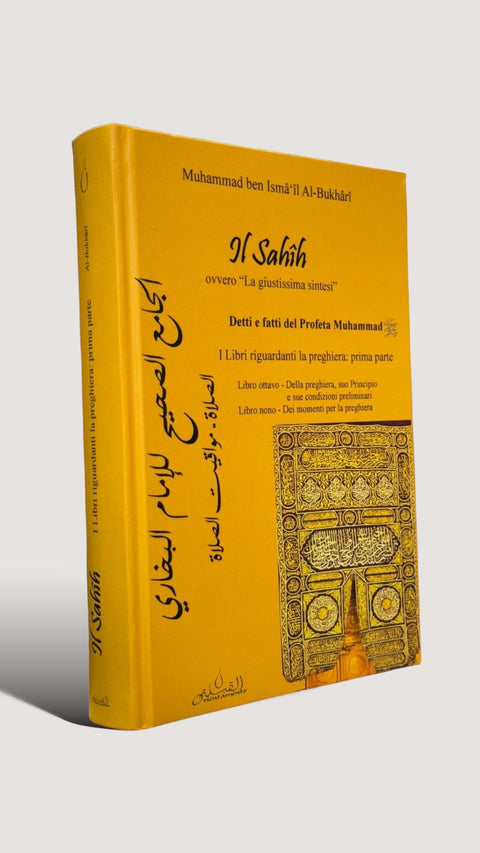


Sahih al-Bukhari – The Books of Prayer (I)
This volume contains a commented translation of two of the ninety-seven ‘Books’ that make up Al-Bukhârî’s Sahîh, the most important collection of hadith (that is, ‘sayings and deeds’) concerning the Prophet Muhammad—may the divine prayers and peace be upon him. These are the eighth and ninth ‘Books’, which constitute the first part of the section of the Sahîh dedicated to prayer (salât), a section comprising sixteen Books in total (from the eighth to the twenty-third), which can thus be divided, for editorial convenience, into four parts:
- first part, Books eight and nine;
- second part, Book ten;
- third part, Books eleven to eighteen;
- fourth part, Books nineteen to twenty-three.
This publication follows those of April 2008, containing the commented translation of the Introductory Books of the Sahîh, namely
- Book one (On the Beginning of Inspiration),
- Book two (On Faith),
- and Book three (On Knowledge),
and that of October 2009, with the Books Concerning Ritual Purification, and therefore
- Book four (On Minor Ablution),
- Book five (On Major Ablution),
- Book six (On Menstruation),
- and Book seven (On Tayammum, or ‘dust ablution’).
As for the ‘logical sequence’ of the first nine Books of Al-Bukhârî’s work—that is, the seven we have already considered and the two studied here—it can be explained as follows. Book one deals with the origin of the traditional Islamic form, with divine inspiration descending upon the Prophet Muhammad (may the divine prayers and peace be upon him); after establishing this initial moment, Book two concerns ‘Faith’ understood as an ‘operative’ expression of the initial and inner moment of inspiration; Book three considers sacred ‘Knowledge’ as the condition and raison d’être of the entire traditional Islamic edifice. The foundations of this traditional edifice are constituted by ‘rituals’, and especially by ‘prayer’ (salât) as the principal moment of conformity to the higher Order and affirmation of the bond with God. However, before addressing the subject of salât, Al-Bukhârî must account for what is necessary to precede it, namely ritual purification, to the various aspects of which the Books of the Sahîh from the fourth to the seventh are dedicated. After that, with Book eight, the discussion turns directly to ‘prayer’: the title of the Book in the original (that is, simply Kitâbu s-salât, ‘Book of Prayer’) marks precisely the departure from the preceding Books and the entry into an argument concerning specifically the ritual sphere.
We have taken the liberty of expanding the title itself in Italian to more appropriately reflect its contents: On Prayer: Its Origin and Preliminary Conditions; indeed, Book eight is not so much about prayer itself as about its divine origin (from the Command of Allah received by the Prophet during the Ascension), and about what constitutes its concrete prerequisite, namely, on the one hand, the proper arrangement of the environment in which it takes place (and thus of the masgid, a term that indicates the ‘mosque’ but not only, as will be seen), and on the other, the preservation of the orientation toward Allah, represented by the qibla, from any intrusion. Once this is established, and other words are used to determine the appropriate arrangement of the ‘spatial’ environment for prayer, Al-Bukhârî turns to Book nine (On the Times for Prayer), where the discussion conversely deals in detail with the ‘temporal’ conditions prescribed for salât.
As can be seen, the two Books we examine here, the eighth and the ninth, which constitute, as has been stated, the first part of the section of the Sahîh dedicated to prayer, are actually a preliminary to the theme, which will be addressed more directly in Book ten, where the principal rite of Islam will be studied in detail, starting from the call to prayer (which will give the Book its title).
A particular note to the reader concerns the manner in which the Sahîh should be read: being a ‘collection of hadith’, Al-Bukhârî’s text undoubtedly allows it to be read at the level of the individual hadith, which can thus be considered on its own as a prophetic indication and consequently contemplated in an operative way. However, there are also two other levels: that of the ‘chapters’ (each of which can be seen as a single treatise) and that of the ‘Books’ (each of which constitutes a doctrinal whole appropriately arranged to unfold the entire range of prophetic teachings relating to a given subject).
In our commented translation, we have sought to invite all three of these readings, so that the reader may fully appreciate the richness of a work constructed with subtle wisdom to enable a profound understanding of prophetic reality, thereby illuminating the reasons for the rituals established on the basis of the example of the Messenger of God (may the divine prayers and peace be upon him) and their own particular modes, thus intuiting, beyond all ‘legalism’ but in profound respect for the venerable Norms, the presence of a divine Wisdom that presides over the Muhammadan sacred Law and guarantees its efficacy and spiritual vitality.
Al-Bukhârî, Muhammad ben Ismâ‘îl:
The Sahîh, or ‘The Most Authentic Synthesis’. The Books Concerning Prayer: First Part.
Campegine (RE) 2013, Edizioni ‘Orientamento/Al-Qibla’,
521 pp.,
ISBN 978-88-89795-15-6